Perspectives
The Third Consumer of Fragrance
We think of fragrance as belonging to the person who wears it. Yet once it leaves the skin, somebody else begins to experience it.
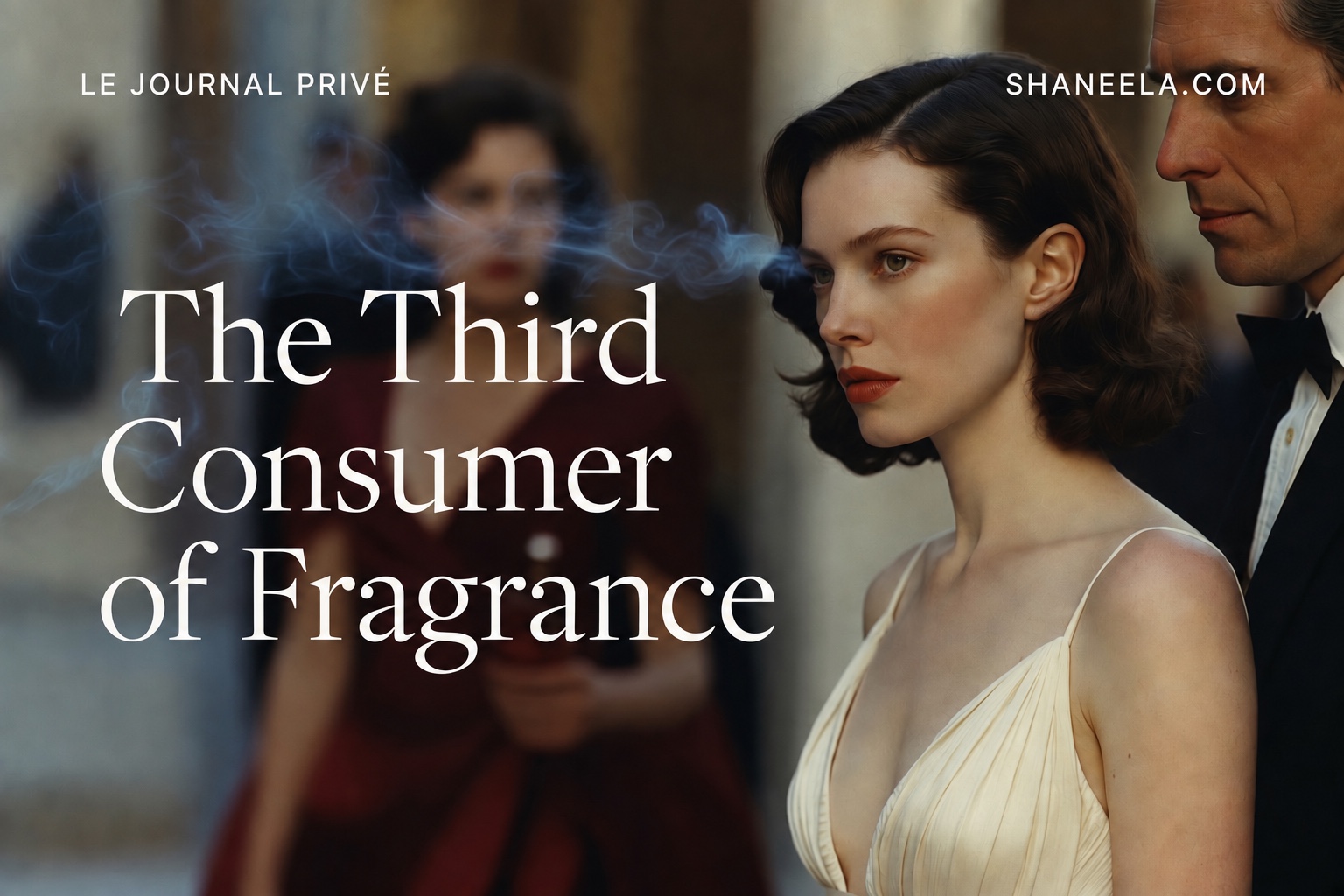
Who is a perfume actually made for?
The obvious answer is the person who wears it. Yet the moment a fragrance leaves their skin, another person becomes involved: the one who smells it.
They did not choose the fragrance. They did not buy the bottle or decide how much to apply. They may never discover its name, who made it or what it contains. Nevertheless, they experience it.
They are the person standing beside the wearer.
This third consumer encounters fragrance without necessarily asking to. A child knows the scent of a parent long before knowing what perfume is. Someone comes to recognise the fragrance worn by a partner. Years later, a stranger passes wearing something similar and, for a moment, a person or place that seemed safely stored in the past returns with surprising clarity.
The bottle belonged to somebody else. Part of the fragrance did not.
Once perfume leaves the skin
Most luxury objects have reasonably clear boundaries. Other people may see a necklace, admire a handbag or sit in a beautifully furnished room, but the object itself remains in the possession of its owner.
Fragrance behaves differently.
Once it is worn, it begins to leave. It moves through a room, remains briefly after somebody has walked away and settles onto clothing, hair and fabric. The wearer controls which fragrance they apply and how much of it they use, but they cannot entirely control who experiences it afterwards.
This makes perfume an unusual possession. We buy something contained inside a bottle, yet its purpose is to escape that bottle and become perceptible to people around us.
Some encounters are momentary and insignificant. Others are repeated for years.
A person who lives or works beside someone wearing the same fragrance regularly may eventually recognise it before consciously thinking about what they are smelling. The fragrance becomes part of that person's presence in much the same way as their voice, mannerisms or the sound of their footsteps approaching.
We often describe a perfume like this as a signature fragrance, but that description usually belongs to the wearer. It suggests a deliberate choice: this is the fragrance that represents me.
The third consumer experiences something slightly different. They may never have decided that the fragrance represents the wearer at all. Repetition makes the association for them.
Eventually, the perfume may stop smelling merely like perfume and start smelling like a person.
The perfume you remember may not be yours
It is quite possible to forget fragrances we once bought for ourselves. Bottles are finished, tastes change and something that felt important for a few years is replaced by something else.
The fragrances worn by other people can behave very differently in memory.
You may not remember the name of the perfume your mother wore, but recognise it immediately if you encounter it again. The scent of somebody you once loved can remain familiar long after the details of what they wore or owned have disappeared from memory. Even a fragrance that was never particularly remarkable as a perfume can become remarkable because of the person attached to it.
This is where the idea of the consumer becomes more interesting.
Commercially, the person smelling the fragrance is almost incidental. They did not generate the sale. They may never become a customer of the fragrance house and may have no desire to wear the perfume themselves.
Yet they are still receiving something.
The wearer experiences fragrance from within their own life. The third consumer experiences it as part of somebody else. Their relationship with the scent is therefore built from a different set of circumstances.
They may associate it with being collected from school, sitting beside someone in a car, getting ready together before going out, or simply being in a particular home. None of these memories belongs to the fragrance itself, but repeated exposure can bind the two together.
The result is rather peculiar. A fragrance that was purchased by one person can end up living for much longer in the memory of another.
Does a fragrance need to be liked to matter?
Fragrance is naturally discussed in terms of preference. We ask whether somebody likes it, whether they would wear it, whether it suits them and whether they would buy it.
For the third consumer, those questions become less useful.
You do not have to want to wear a fragrance for it to become important to you. You might not even think it is especially beautiful. If somebody significant in your life wears it often enough, your relationship with that fragrance can develop independently of whether you would ever have chosen it for yourself.
This is one reason the third consumer should not simply be understood as an audience a perfume ought to please.
If fragrance houses began treating this person as another customer to satisfy, the idea would quickly collapse into the familiar question of whether a perfume attracts compliments. That is not what makes the third consumer interesting.
Their importance lies in the fact that they are not choosing.
The wearer can decide that a fragrance no longer suits them and stop wearing it. The person who has spent years associating that scent with them cannot make the association disappear quite so deliberately.
In this sense, the success of a fragrance can have another dimension beyond whether people want to own it. Some perfumes become memorable because they acquire a human identity in the minds of people who never possessed them.
That is difficult to design deliberately, and perhaps it should remain so. A perfumer can create something distinctive, beautiful or recognisable, but cannot decide whose life it will enter or what will happen there.
Once the fragrance is worn, that part belongs to other people.
When the bottle remains
There is one more person who complicates the idea of who a fragrance is for.
Perfume bottles sometimes outlive the people who wore them.
An unfinished bottle may remain on a dressing table or inside a drawer and eventually pass into somebody else's hands. The person who inherits it might never have chosen the fragrance for themselves. They may not even want to wear it.
Yet smelling it can suddenly make the absent owner feel extraordinarily close.
At this point, the bottle has changed. It may still contain perfume, but using the perfume is no longer necessarily its most important purpose.
In fact, the new owner may become reluctant to use it at all. Every spray reduces the amount that remains, and unlike a photograph or a piece of jewellery, fragrance is depleted by the very act that brings it back to life.
A bottle that once existed to be emptied can therefore become something somebody tries to preserve.
This person is different from the third consumer who simply encountered the fragrance around its wearer. They now possess the physical object as well as the memory attached to it. What was once another person's perfume has become an artefact of that person.
It is difficult to think of many possessions that move between these roles so easily. Fragrance begins as something selected to be worn on the body. It then enters the space around the wearer, where other people experience it and form associations of their own. Years later, the remaining bottle may survive as a physical connection to the person who once wore it.
The fragrance industry can know who purchased a bottle. It can know something about the person it hopes will wear it. What it cannot know is who else will carry that fragrance with them.
We choose what perfume to put on our skin, but we do not choose which scent another person will eventually remember as ours.
That decision is made somewhere else, in someone else's memory.