Perspectives
Perhaps Luxury Was Never About Rarity
Rarity can begin with the maker. But after decades of ownership, an exceptional object can acquire something its maker could never have created alone.
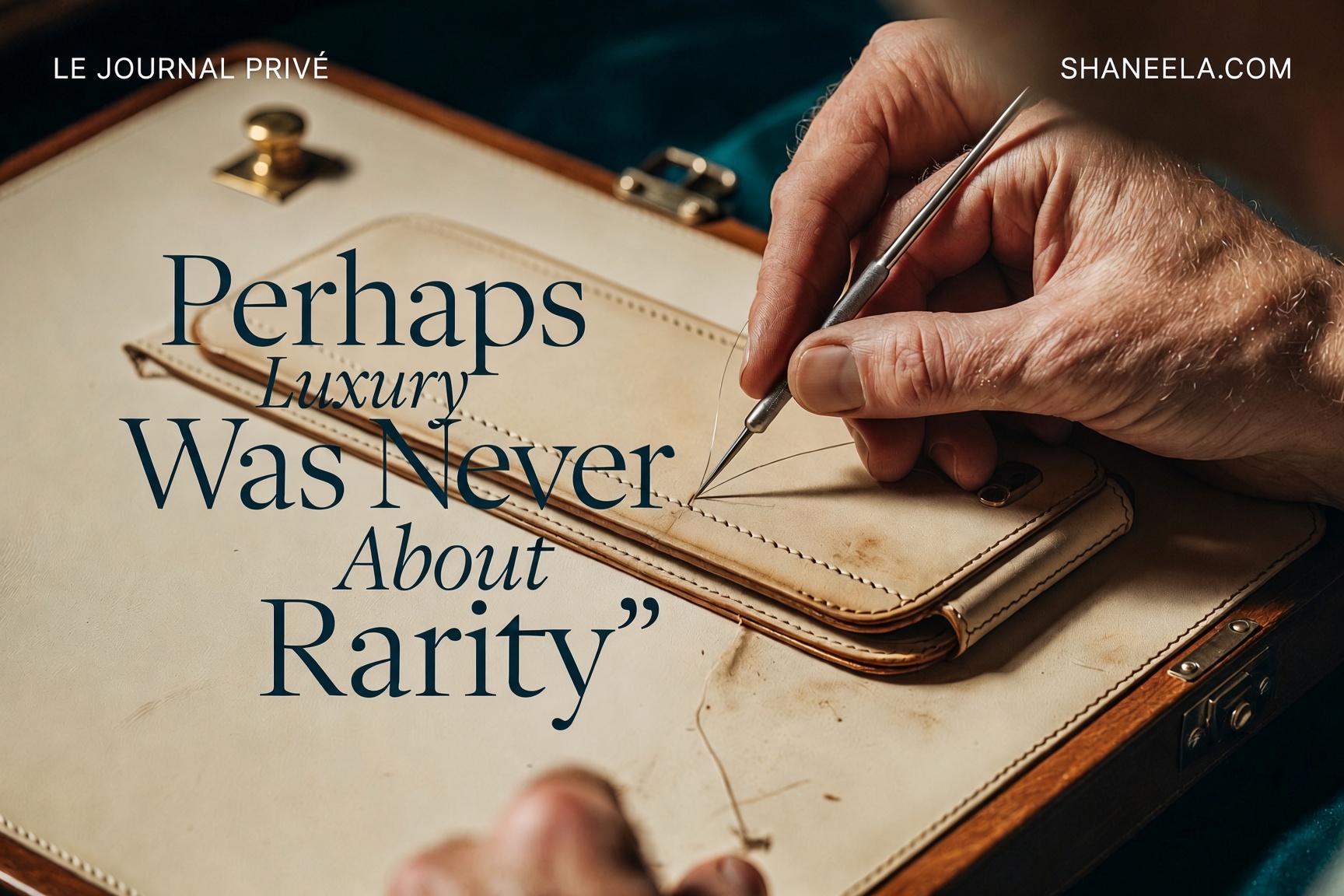
If only five examples of something exist, is it more luxurious than something five million people own?
Yes, quite possibly.
There are good reasons why some of the finest things exist in small numbers. Exceptional materials may be difficult to obtain. Making something by hand takes time. A particular craft may depend upon skills possessed by very few people, while the pursuit of an unusual idea may make large-scale production neither possible nor desirable.
Rarity can therefore tell us something meaningful about an object.
But that still leaves an interesting question. If rarity contributes to luxury at the moment something is made, what happens to that object after somebody begins to live with it?
Imagine one of those five objects remains with the same person for forty years. It travels with them, acquires marks from use, is repaired rather than discarded and eventually passes to somebody else in the family.
There are still five examples in existence. Yet this one is no longer simply one of five.
Something has happened to it that the other four do not share.
Its maker created its rarity. Its owner created its history.
What happens after something is made?
We tend to describe luxury according to the qualities an object possesses when it is new. We talk about its materials, craftsmanship, provenance, design and the number produced. These things matter because they tell us something about the thought, skill and resources that went into creating it.
Yet an object can have a remarkably long life after it leaves the hands of its maker.
During that life, its condition will almost certainly change. Leather softens. Metal develops fine scratches. Fabric fades. Something may need to be repaired. An object that was once immaculate begins to carry evidence that somebody has actually lived with it.
Conventionally, many of these changes are treated as deterioration. If two otherwise identical objects appear at auction and one is pristine while the other is heavily worn, condition may quite reasonably affect their commercial value.
But ownership introduces another way of looking at those same changes.
A repair can be evidence that somebody thought the object worth saving. Wear can tell us which part was repeatedly touched. An alteration may reveal that an object was adapted to remain useful rather than replaced when circumstances changed.
None of this necessarily makes an object more valuable to the market. It can, however, make that particular example increasingly distinct from every other one that was originally made beside it.
The object is no longer merely ageing. It is becoming specific.
From one of five to one of one
This is where limited production becomes particularly interesting.
Suppose five objects leave a workshop on the same day. They share the same maker, materials and design, and each is already rare because no sixth example will be made.
Then their lives separate.
One remains carefully stored. Another changes owners several times. A third is used constantly and repaired. Another disappears into a private collection. The fifth remains in one family and is eventually inherited.
Decades later, describing them simply as five examples of the same thing no longer tells us very much about them.
They began with a shared provenance, but each has since acquired another provenance of its own.
This is a form of individuality that cannot be completely designed at the beginning. The maker can give an object the quality required to survive, and perhaps that is one of the most important contributions craftsmanship makes to its future. Something poorly made may never have the opportunity to become an heirloom because it does not last long enough.
A well-made object has the chance to remain.
What happens during that remaining is beyond the maker's control.
This is why the idea of something becoming “one of one” does not have to mean that only one example was ever created. An object can begin as one of five, one of thirty or one of several hundred and gradually become singular because no other example has lived precisely the same life.
Its original rarity has not disappeared. Something has been added to it.
Perhaps luxury needs time
This also raises a question about when luxury is complete.
We usually assume that the creation of an object ends when it leaves the workshop. The maker has finished the work, the customer acquires it, and from then onwards the task is largely one of ownership and care.
But perhaps some objects continue to be made in another sense.
Not physically, of course. The owner is not improving the craftsmanship by scratching a surface or wearing down a handle. Yet they are creating the particular object that will eventually exist decades later.
This is especially apparent when things are inherited.
The person receiving an older object does not encounter it in the same condition in which the first owner did. They receive the maker's work together with everything that happened afterwards. The original materials and craftsmanship are still there, but so are the choices of the people who kept it.
They chose to repair rather than replace it. They stored it when it was not being used. They moved it from one home to another. Most importantly, at some point somebody decided that it should pass to another person rather than leave the family entirely.
By then, its rarity is no longer explained adequately by the number originally produced.
There may be other examples available. There may even be another in better condition.
But another one would not necessarily do.
Rarity as the beginning
Perhaps, then, the problem is not our fascination with rarity. It is the tendency to think of rarity as something fixed at the moment of creation.
There is the rarity a maker can create through exceptional materials, difficult processes, limited production and the refusal to make more simply because more could be sold. That rarity can be meaningful from the very beginning.
Then there is another kind that develops much more slowly.
An object survives. It becomes associated with a particular person. Its pristine surface gives way to the evidence of use. Its history becomes increasingly difficult to separate from the physical thing itself.
Eventually, replacing it with another example becomes almost beside the point.
This may be one reason durability matters so much in luxury. Longevity is not valuable merely because an object continues to function. It gives the object time in which to become something its maker could never have produced alone.
A newly made object can be rare, extraordinary and beautifully executed. It can deserve to be preserved from the first day of its existence.
But the object that returns forty years later is carrying something else.
The maker provided the materials, skill and intention that allowed it to begin its life as something exceptional. The owner provided the years in which it became particular to them.
Neither diminishes the other. In fact, the two may be most powerful when they meet.
Perhaps luxury was never about rarity alone.
Perhaps rarity is what allows an exceptional object to begin as one of very few, while time, ownership and survival are what can eventually make it one of one.