Perspectives
The Things the Market Cannot Price
We know how to determine what an object costs. It becomes much more difficult when we try to explain what makes it valuable.
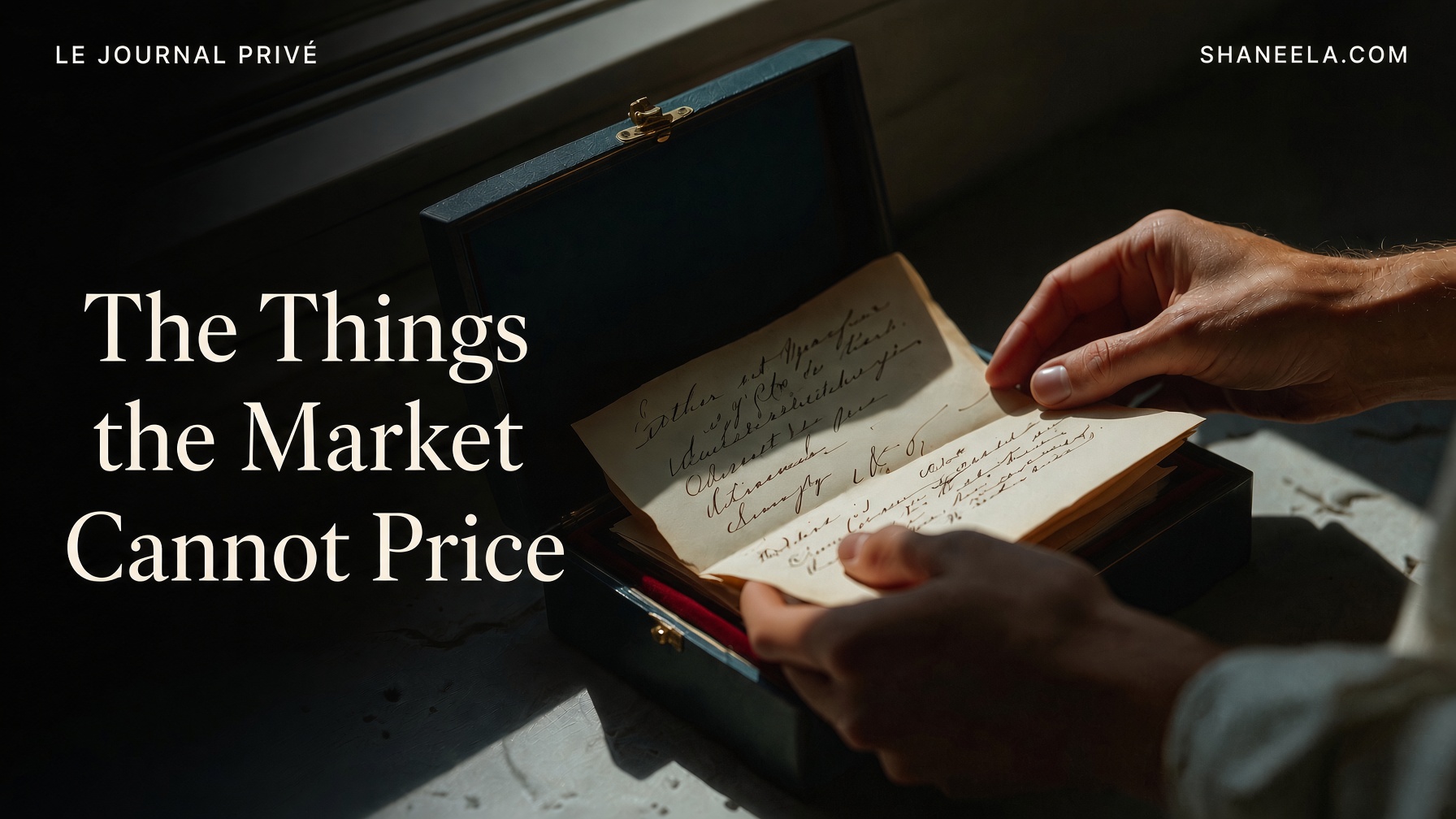
What is the most valuable thing you own?
Before you answer, remove your home, your car, your investments and anything else you could sell tomorrow for a substantial sum.
What is left?
It might be a piece of jewellery, an old letter, or something so ordinary that nobody else would understand why you have kept it.
Now imagine somebody offers you ten times what it is worth. Would you sell it?
For certain things, the answer is still no. Raise the offer again and it remains no. At some point the exercise becomes rather strange because, although the object has a price, the price has surprisingly little to do with the reason we value it.
This presents an interesting problem. We talk about value constantly, particularly in luxury, but we are often talking about very different things without acknowledging it.
A watch can be valued. So can a diamond or a handbag. We can consider materials, condition, rarity, provenance and previous sales, then arrive at a figure. Within reason, the market can tell us what somebody else is likely to pay.
But what happens when the reason something matters cannot be transferred to its next owner?
An old watch might be worth £2,000 on the market. If it belonged to your father, its value to you may have almost nothing to do with the £2,000. A buyer acquiring it tomorrow gets the watch, but they do not acquire your father or your memories of him. That part of its value disappears at the moment of sale.
The history nobody records
Luxury understands provenance very well. Tell us that an object was made in a particular workshop, belonged to an important person, or was produced in unusually small numbers, and its history can materially alter its price.
Yet most objects have another provenance that nobody records. Who gave it to you? Where did it travel with you? Why, after everything else that has come and gone, did you keep it?
None of this is likely to appear in a valuation report, but it can eventually become the reason an object survives.
This also creates an interesting contradiction. Age and use often reduce an object's resale value, yet the owner may feel precisely the opposite. A handwritten note, an old repair or even a scratch can matter because its significance belongs to the history of that particular object.
Improving something commercially can therefore mean removing the very things that made it important personally.
Rarity is not always about numbers
Luxury is fascinated by rarity. We number editions, restrict production and seek materials that are difficult to obtain. An object naturally becomes more desirable when very few people can own one.
But there is another form of rarity that has nothing to do with how many were manufactured.
Suppose you inherit a bracelet of which 20,000 identical examples were made. It is not rare. You could lose it tomorrow, search online and purchase exactly the same model.
Except it would not be the same bracelet.
There may be thousands of examples of the object and only one example of your object. Its scarcity was not created in a workshop. It was created by time.
This kind of rarity cannot be manufactured in advance because nobody knows which objects will acquire it. Something deliberately purchased as an heirloom might eventually be sold, while an inexpensive possession is kept for another fifty years because it happens to carry the stronger memory.
We can choose what we leave behind. We cannot entirely choose what somebody else will find precious.
What the market is actually measuring
None of this makes financial valuation meaningless. Markets need a common language, particularly when two people with no relationship to each other are buying and selling an object.
If you are selling a watch to a stranger, the fact that you wore it on the day your child was born cannot reasonably add thousands to the asking price. The memory belongs to you, not to the buyer.
The market therefore asks a much narrower question: what is this object worth to somebody who does not know you?
That is a useful question, but it is not the same as asking what the object is worth to you.
A market valuation has to leave out almost everything that cannot travel with the object when ownership changes. This is why an owner and a prospective buyer can look at the same thing and arrive at completely different ideas of its value. The buyer is considering what they would acquire. The owner is also considering what they would lose.
What would you save?
There is another way to test all of this.
Imagine you had to leave your home and could take only a handful of possessions. What would you choose?
Most of us probably would not begin by checking which objects had performed best on the resale market. The decision would expose a different hierarchy of value, one in which an inexpensive possession might suddenly outrank something worth considerably more.
Some objects become valuable only after we have owned them. They collect a private history that cannot be sold with them, insured with them or recreated by purchasing another example. Sometimes we do not even realise this has happened until we are faced with losing them.
This may also be why the things that eventually become heirlooms are not always the things originally intended for that purpose. An ordinary possession can become important simply because it remained while life happened around it.
The market can tell us what somebody might pay to take an object from our hands. What it cannot tell us is how much we would need to be paid to let it go.
For some things, those two numbers will never meet.